Wednesday, December 16, 2009
Whitewater Rescue Manual - New Techniques for Canoeists, Kayakers and Rafters - 1995 book review.
River Safety & Rescue Methods for White Water Paddleboaters & Swiftwater Rescuers.
"In Whitewater Rescue Manual , two paddlers who have long been at the forefront of whitewater safety and rescue present a tightly focused look at the best, most current techniques for both self-rescue and rescue of others on the river. The authors provide well-reasoned guidance that will teach you when to stay with the boat and when not to; how to retrieve a lost boat; how to swim out of trouble and when not to swim; how to reach a victim by wading, swimming, or using ropes; how to coordinate a rescue effort; how to make sure that would-be rescuers don't become victims; how to properly perform first aid and safely evacuate injured paddlers; and much more. This well-illustrated guide is essential reading for canoeists, kayakers, and rafters of all levels--as well as river guide trainees, participants in river rescue courses, and whitewater instructors." , two paddlers who have long been at the forefront of whitewater safety and rescue present a tightly focused look at the best, most current techniques for both self-rescue and rescue of others on the river. The authors provide well-reasoned guidance that will teach you when to stay with the boat and when not to; how to retrieve a lost boat; how to swim out of trouble and when not to swim; how to reach a victim by wading, swimming, or using ropes; how to coordinate a rescue effort; how to make sure that would-be rescuers don't become victims; how to properly perform first aid and safely evacuate injured paddlers; and much more. This well-illustrated guide is essential reading for canoeists, kayakers, and rafters of all levels--as well as river guide trainees, participants in river rescue courses, and whitewater instructors." |
Whitewater Rescue Manual - Critical Analysis.
"Whitewater Rescue Manual" is an excellent resource on whitewater rescue for advanced paddleboaters. The book needs much more basic river safety information for beginning boaters. For example, there is little or no information about how to recognize safety hazards on the river. The basic river safety & river rescue information that is provided is scattered throughout the book mixed together with information for advanced boaters and swiftwater rescue professionals.Overall, I rate "Whitewater Rescue Manual" as a good resource for whitewater river rafters, kayakers & canoeists (*** 3 stars out of 5).
More about:
• Basic Paddling & River Safety Skills for Class II Whitewater Kayaking - BRT Insights.
• White Water Rescue Skills & Paddleboating Techniques - BRT Insights.
IceRocket Tags: kayaking, whitewater, river, swiftwater rescue.
Tags: paddlesports, kayaking, kayaking technique, paddle boating, whitewater, river, rafting, canoeing.


Monday, November 02, 2009
Use the Buddy System for Safety Teamwork on Whitewater River Kayaking, Innertubing & Canoeing Trips.
While talking with a kayaking friend recently he described a large kayaking group that spread out while going down the river. At some point he realized that none of the nearby boaters were paying any attention to his safety, so if he had a swim or an entrapment it would have been a very long time, if ever, before anybody would have come to help.
More about: Safety Skills & Techniques for Whitewater River Paddleboating.
IceRocket Tags: kayaking, river tubing, float tube, kayaking technique.
Technorati Tags: kayaking, river, whitewater, paddlesports, paddle boating, canoeing.
Safety skills & teamwork for small kayaking, innertubing & canoeing groups.
In a small paddleboating group everybody should be everybody else's buddy. Every buddy is responsible for watching out for everybody else's safety - every minute, all day, no exceptions. Even boaters who don't have the skill or strength to be primary rescuers should at least be watchful and raise the alarm as soon as they see somebody needing help. Everybody is responsible to stick together with the group, to watch out for the safety of others and to enable others to watch out for you. Solo boaters who drift apart from the group and don't participate in this teamwork for safety are simply not welcome in my boating group.Safety skills & teamwork for large kayaking, innertubing & canoeing groups.
Big groups of paddle boaters inevitably spread out so it is not possible for everybody to watch out for the safety of everybody all day on the river. If the safety awareness of a big group or many individuals in the group is not so good, then it may not be easy for an individual to change that. Individuals on a group trip can nevertheless improve their own safety on the river by teaming up with a buddy or a small group of safety-minded individuals. If your small group sticks closely together while boating, then you can improve your own safety despite the other paddleboaters in your big group who may not be so safety conscious.More about: Safety Skills & Techniques for Whitewater River Paddleboating.
IceRocket Tags: kayaking, river tubing, float tube, kayaking technique.
Technorati Tags: kayaking, river, whitewater, paddlesports, paddle boating, canoeing.
Labels: technique
Monday, August 24, 2009
Ultimate Guide to Whitewater Kayaking, 2004 - book review.
An excellent reference book that covers a wide range of whitewater river kayaking skills and techniques.
The Ultimate Guide to Whitewater Kayaking provides "detailed illustrations, stunning photos and literary contributions from the world's most notable paddlers. ... this manual covers everything from the most basic skills and concepts to the most advanced, cutting edge paddling techniques. .... You'll learn: to choose the right equipment, the essential strokes and paddling techniques, the art of reading whitewater, river running techniques, river safety and rescue, playboating techniques, creek boating skills, big water skills, surf kayaking technique, squirtboating, slalom and much more." provides "detailed illustrations, stunning photos and literary contributions from the world's most notable paddlers. ... this manual covers everything from the most basic skills and concepts to the most advanced, cutting edge paddling techniques. .... You'll learn: to choose the right equipment, the essential strokes and paddling techniques, the art of reading whitewater, river running techniques, river safety and rescue, playboating techniques, creek boating skills, big water skills, surf kayaking technique, squirtboating, slalom and much more." |
In its 288 pages this book does a great job of describing a wide range of whitewater river kayaking techniques. It includes chapters on: Equipment, Before Hitting the Water, The Essentials, Strokes, Rolling a Kayak, Anatomy of Whitewater, River Running, Big Water River Running, Creeking, Playboating, Whitewater Racing, Surf Kayaking, Squirt Boating, River Safety & Rescue, River Etiquette, Tips for Women, Travelling & Kayaking, Overnight Whitewater Trips. The book is very well illustrated with B&W photos and diagrams.
Shoulder safety principles - Power Position and Paddler's Box.
The book describes good techniques for maintaining shoulder safety (pg 26-28). It is very important for kayakers to keep their hands in front of their shoulders in the "power position" when paddling. Another way of describing the same concept is the "paddler's box kayaking technique" that I have advocated previously. The critical principle is that the hands (or elbows) should never be allowed to move behind the shoulders because this body position greatly increases the risk of shoulder dislocation when paddling a kayak.Problems with forward sweep stroke kayaking technique.
These shoulder safety principles are totally violated just a few pages later in this book in the description of forward sweep stroke techniques (pg. 41-43). The book describes first turning head and shoulders in the desired direction of the turn and then reaching far back on the other side of the kayak to make the sweep stroke. This inevitably puts the hand far behind the shoulder in a very risky shoulder dislocation position. This may be the high performance turning method that many advanced kayakers are using to turn the modern short kayaks. Nevertheless, I don't advocate teaching this very risky technique to beginning paddlers whose shoulder muscles may not be strong enough to survive the risky shoulder dislocation position. I think that beginning kayak paddlers should be taught the traditional method of turning the head to follow the paddle blade in the water when doing the sweep stroke. This provides the best shoulder safety and helps the beginning kayaker to focus on first learning to engage torso muscles to make the boat turn efficiently.Conclusion.
I have great concerns about the description of forward sweep stroke technique, but other than that everything else in this book is quite excellent. I rate this book as a great resource for whitewater river kayakers (**** 4 stars out of 5).More about:
• Principles of kayak paddling strokes, The Paddler's Box - BRT Insights.
• Sweep Stroke for Turning Your Kayak, the traditional method - BRT Insights.
• Book reviews for whitewater river kayaking, rafting & canoeing - BRT Insights.
• White Water Kayaking Skills & Techniques - BRT Insights.
IceRocket Tags: kayaking.
Tags: paddlesports, kayaking, kayaking technique, paddle boating, whitewater, river.
Sunday, August 09, 2009
Essentials of River Kayaking, 2004 - book review.
Introduction to whitewater river kayaking techniques for beginning paddleboaters.
Essentials of River Kayaking provides a brief, quick introduction to a wide range of important skills & techniques that all whitewater river kayakers need to know about. Topics include: how to be safe on the water, kayaks & paddles, getting the kayak onto the river, kayaking strokes, kayaking on moving water, rescue & safety. None of these techniques can be covered completely in this very short booklet, but the booklet does provide a foundation of basic knowledge that can help prepare a beginning paddleboater to continue learning more from other sources in the future. provides a brief, quick introduction to a wide range of important skills & techniques that all whitewater river kayakers need to know about. Topics include: how to be safe on the water, kayaks & paddles, getting the kayak onto the river, kayaking strokes, kayaking on moving water, rescue & safety. None of these techniques can be covered completely in this very short booklet, but the booklet does provide a foundation of basic knowledge that can help prepare a beginning paddleboater to continue learning more from other sources in the future. |
More about:
• Book reviews for whitewater river kayaking, rafting & canoeing - BRT Insights.
• White Water Kayaking Skills & Techniques - BRT Insights.
Tags: paddlesports, kayaking, paddle boating, whitewater, river.
Wednesday, August 05, 2009
River Tubing Skills, Techniques and Safety for your Float Tube River Trips.
Float tubes (innertubes) are the ultimate in economy and simplicity among personal watercraft!!
River tubing provides the first river trip experiences for many people. This generally works out OK as long as beginning river tubers stick to gentle sections of river. Even on a gentle section of river there are still things to know to help promote fun and safety in river tubing.Equipment for River Tubing.
The float tube can be a truck innertube from a tire store or a float tube from a sporting goods store. PFDs (life jackets) are always recommended and sometimes required depending upon the speed of the river and local regulations. This equipment can often be rented from outfitters located near rivers that are popular for river tubing. (Equipment for Float Tubing - BRT Insights.)Hats & sunglasses should be tied on securely. Short ropes can be used to tie gear on your person or on your float tube. Never tie things together with a long length of rope in between. Avoid long dangling ropes that can get snagged on various obstructions in the riverbed and cause a safety hazard. An old pair of gym shoes or securely attached sandals are important for walking in and around the river. Be sure to bring lots to drink to stay well hydrated. Sunscreen is highly recommended and should be reapplied frequently.
Skills Training and/or Experience for River Tubing.
Beginners should go with more experienced river tubers who are familiar with the river, or start with gentle rivers that are recommended for self-guided trips. Everybody who goes river tubing should have good swimming skills because there is a risk of getting tipped over and separated from your float tube.Choosing a River for your Float Tube Trip.
Rivers are rated from class I (flat moving water) to class V (extreme whitewater) on the International Scale of River Difficulty. Beginning river tubers should stick to class I & II rivers. Rivers that flow near to a road are best for beginning tubers so they can walk out easily in case of trouble.River Tubing in California.
River difficulty ratings for many California rivers are available from websites (California River Boating Online Guide) and books (Paddling Northern California & Ann Dwyer's Easy Waters of California North). There are also websites that provide recent flow data (Dreamflows - Western USA) to help ensure that when you plan a river tubing trip there will be sufficient flow in the river when you get there. In northern California river tubing is popular on American River Parkway class I+, Cache Creek Rumsey Run class II+, Russian River class I, Sacramento River class I-II and Truckee River due to their reliable summer flows and relatively warm water.Floating down the River in your Float Tube - Watch out for Safety.
Typically we leave one vehicle parked near the river take-out location and one vehicle at the river put-in location. When floating the river keep your group close together and make sure everybody is watching out for the safety of everybody else at all times. Even on the mildest of rivers the power of flowing water is incredible. Be sure to avoid logs and bushes in the current that can snag a boat or a boater. Don't let the currrent push you into a channel that is too narrow to pass through safely. Whenever you cannot see a safe route down the river get out on the shore to find a good route or to walk around a difficult section of the river. Don't let the current push you underneath an overhanging rock, tree or shoreline because you could get trapped underwater. Keep your feet up and swim if you get tipped out of your float tube in an area of strong current. Don't walk in the riverbed in places where the current is strong because if your foot gets wedged in a crevice then the current could push you under. Avoid the upstream side of rocks, bridge pilings or other obstructions in the riverbed. Man-made structures in the riverbed are typically very hazardous, so be sure to float far away from them or walk past them on the shore if necessary.River Tubing Photos & Videos.
• YouTube - River Tubing Tour, Ocho Rios Jamaica.• river tubing - Google Images.
• river tubing pictures and videos on Webshots.
• Picasa Web Albums - river tubing Search results.
• YouTube - river tubing search.
• Axel Tubing on the American River - LiveVideo.com
• Mokelumne River Trip 2006 - Tubing the River
• Saskia Tubing on the American River - LiveVideo.com
• river tubing - Google Videos
Good luck, watch out for safety and have fun out there!!
More about:
• Tube Information and Safety - TubeNation - Ride the Tube!
• Use the Buddy System for Safety Teamwork on Whitewater River Trips.
• Skills & Techniques for Whitewater River Float Trips.
IceRocket Tags: river tubing, float tube.
Technorati Tags: river tubing, float tube, river, whitewater, California.
Labels: technique
Saturday, July 18, 2009
Play Daze, kayak playboating instructional video, VHS 1999 - review.
Play Daze [VHS video] "Recognizing that instructional techniques should evolve with boat designs, Play Daze introduces the skills needed to take full advantage of today's playboats. You'll learn how to front and back surf more effectively, spin on smaller waves, link endless cartwheels, and stun your friends with wave wheels or kick flips." |
"Play Daze, by Ken Whiting and Chris Emerick. Playboating is all the rage these days, but despite how easy the pros make it look learning the moves takes time, dedication, proper technique and a flood of freestyle trial and error. Former World Rodeo Champion Ken Whiting’s instructional video, Play Daze, provides all that and more, taking paddlers from front surfing to kickflips and all points in between. Play Daze won the prestigious “Professional Instruction/Safety” class award at this year’s National Paddling Film Festival in Kentucky. It provides rodeo instruction for all levels of playboaters, starting with the basics of front surfing and balance, before moving on to advanced techniques. Play Daze offers the chance to learn from some of the best playboating instructors in the world. - Nate Johnson" (Paddler Magazine, june2000)
Three Golden Rules of Whitewater Kayak Playboating Technique.
The video explains three golden rules for kayaking: power the paddle via torso rotation, upper body and lower body work independently to control paddle and kayak, and control the kayak with an active paddle blade in the water. Then these important basic rules are applied to all of the kayak surfing and playboating skills.Basic Moves for Kayak Freestyle Playboating.
The video describes front surfing, back surfing, stern squirts, side surfing, 360's, flat spins, and back desk roll.Advanced Moves for Freestyle Kayaking in a Playboat.
The video describes cartwheels, splitwheels, flatwater cartwheels, wathunck, wavewheels, blunts, back stab, and kick flips.The video does a good job of introducing many different playboating moves for whitewater river kayaking. A little more explanation of the progression of moves needed to complete some of these maneuvers would be helpful. The maneuvers zip by too fast when viewed at normal speed in the video. It would have been nice if the video replayed the maneuvers in slow motion with more narration. To get the most out of this video you need a video player that can run the video in slow motion so you can do your own detailed analysis of these maneuvers. I rate this video as good (*** 3 stars out of 5).
More about:
• Critical reviews of books and videos for whitewater river kayaking - BRT Insights.
• Skills & Techniques for Whitewater River Kayaking - Freestyle Playboating.
IceRocket Tags: kayaking.
Tags: kayaking, whitewater, river, paddle boating, paddlesports, playboating.
Thursday, July 16, 2009
SOAR - Skills On All Rivers: Intermediate and Advanced Kayaking Technique, VHS 2000 - review.
SOAR - Skills On All Rivers: Intermediate and Advanced Kayaking Technique [VHS video] describes techniques for whitewater river kayaking with the modern short boat style of kayaks. "Just as kayak designs have evolved, so have the paddling techniques needed to take advantage of them. 'SOAR' follows some of the best paddlers in the world on a breathtaking journey to the Zambezi River in Africa and to the magical creeks of New Zealand while introducing the skills needed for intermediate and advanced kayakers to excel. Learn 'The Golden Rules of Kayaking', optimize your strokes, improve your creek boating, and polish your big water paddling." describes techniques for whitewater river kayaking with the modern short boat style of kayaks. "Just as kayak designs have evolved, so have the paddling techniques needed to take advantage of them. 'SOAR' follows some of the best paddlers in the world on a breathtaking journey to the Zambezi River in Africa and to the magical creeks of New Zealand while introducing the skills needed for intermediate and advanced kayakers to excel. Learn 'The Golden Rules of Kayaking', optimize your strokes, improve your creek boating, and polish your big water paddling." |
Three golden rules for whitewater river kayaking paddling technique.
1. Separate the movements of upper and lower body. It is critical to be able to paddle with the upper body while independently using the lower body to steer and edge the boat with knee and hip action.2. Torso rotation.
a.) Power paddle strokes with torso rotation. Torso rotation muscles provide your best power and endurance to power your paddle.
b.) Turn your kayak with torso rotation. With the new short kayak designs first look where you want to go as you wind up your torso. Second plant your paddle blade on the inside of the desired turn as a pivot. Third unwind your torso back to a neutral position while using torso muscles to pull the kayak into the desired direction. This is opposite of the old methods for long kayaks where we used the paddle on the outside of the turn to push the kayak into the desired direction!!
3. Keep an active paddle blade in the water at all times to maintain control of your kayak. Whenever there is no paddle in the water a modern short kayak can be knocked off course easily and quickly even by tiny waves or currents.
Optimizing your kayaking paddle strokes.
The video demonstrates how to apply the golden rules of kayak paddling to your sweep stroke, draw stroke and back stroke.Advanced techniques for whitewater river running.
The video demontrates and discusses techniques for eddy turns, river running safety, creek boating, and big water boating.I rate this video as outstanding (***** 5 stars out of 5).
More about:
• Critical reviews of books and videos for whitewater river kayaking - BRT Insights.
• Skills & Techniques for Kayaking on Whitewater Rivers.
IceRocket Tags: kayaking.
Tags: kayaking, whitewater, river, paddle boating, paddlesports.
Tuesday, July 14, 2009
Essential Boat Control, whitewater kayaking techniques video, 1996 - review.
Essential Boat Control is "a music filled instructional video pushing the foundations of good kayaking. Created for the intermediate to expert paddler, this video is not a topical smattering of tricks to impress your friends. This is the REAL THING." is "a music filled instructional video pushing the foundations of good kayaking. Created for the intermediate to expert paddler, this video is not a topical smattering of tricks to impress your friends. This is the REAL THING." Essential Boat Control - 1998 Winner - National Paddling Film Festival Commercial & Professional Winner: Instructional video category. | |  |
Essential Boat Control describes 3 important principles for whitewater kayaking: balance, speed control and direction control. These principles are applied to the paddling techniques for entering eddies and exiting eddies. Essential strategies for kayaking in and out of eddies: posture, controlling turns, controlling speed, vision, navigation timing, eddy turn variables, edging, front & back leaning, maintenance strokes, enhancement strokes, linking maneuvers, and boofing.
This video was produced in 1996 at the end of the long boat period, but the skills & techniques described are still relevant to the shorter kayaks that are currently popular for river kayaking. Some additional information from other sources is needed to take full advantage of the modern short kayaks. Nevertheless, I still rate this video as great (**** 4 stars out of 5).
More about:
• Critical reviews of videos and books for whitewater river kayaking - BRT Insights.
• Techniques & Skills for Whitewater River Kayaking - BRT Insights.
Tags: kayaking, paddle boating, paddlesports, whitewater, river.
Friday, July 25, 2008
How to get started in whitewater river kayaking.
Training is important for good performance & safety skills on the river.
1. Take some training classes in whitewater river kayaking.
Instruction from an experienced teacher is critical to learn eskimo roll, good paddling techniques, river running skills and river safety skills. Avoid the common beginner mistakes. Don't let yourself develop bad habits that will need to be corrected later. Good instruction is the key to more fun, rapid advancement in skills and better safety on the river.• Basic skills training classes for whitewater river kayakers in northern California.
2. Join a kayaking club.
Kayaking attracts the rugged individualists who insist upon being captain of their own boats! Nevertheless, we typically team up with others for transportation to and from the river and for safety & rescue while on the river. Clubs help beginning kayakers to continue their learning on river trips together with more experienced kayakers. Clubs typically help beginners decide which equipment to buy and may be a source of used equipment for sale.• Clubs for northern California whitewater river kayakers.
3. Buy a whitewater kayak and other necessary gear.
New or used kayaking equipment can be purchased from a variety of sources.• Kayaking Equipment Purchase Directory.
4. Books, videos & websites on river kayaking.
Reading books and watching videos can provide supplemental information about kayaking skills, but classes and guidance from experienced kayakers is still critical when practicing these skills on the river.• Reviews - Books, Videos, & Websites about kayaking on whitewater rivers.
More about: Kayaking Skills & Techniques for Whitewater Rivers.
Tags: kayaking, paddle boating, river, whitewater, California.
Labels: technique
Thursday, August 09, 2007
Kayakers need to operate upper body and lower body independently
Important technique for intermediate-level kayak paddling in whitewater rivers
Beginning kayakers
Beginning kayakers are typically focused on using their arms, shoulders and torso to power their paddles. Many people kayak on class II whitewater rivers using just their upper body muscle strength to power their paddles. Some kayakers even advance to class III whitewater rivers using this strong arm style of paddling. Even the strongest person will eventually find their kayaking performance limited by this style of paddling. Paddling with brute force also makes our bodies locked up stiff with muscle tension and may result in tipping over frequently when the whitewater starts to bounce us around.
 |  |  |
Intermediate kayakers
Kayakers make a leap in performance when they realize the power of steering their boats with their knees and hips. Using these lower body muscles to control the left-to-right rotation of the kayak makes the boat into a giant rudder helping to steer in the desired direction. This frees the paddle and the upper body muscles to focus more on providing propulsion. Kayakers who can simultaneously control the paddle with their upper bodies and control the boat with their lower bodies get a big performance advantage. This requires that we unlock our midsections to allow upper body and lower body muscles to work separately, independently and simultaneously.
 |  |  |
More about: Whitewater Kayaking Techniques.
Tags: rivers, kayaking, whitewater.
Labels: technique
Wednesday, July 04, 2007
Forward Sweep Stroke - Kayak Paddling Technique
Good technique will give good performance on whitewater river trips.
Whitewater kayaks are designed to turn quickly and easily. Waves and currents in a whitewater river will often spin the boat in undesirable directions if you let them. Sweep strokes are important to keep the kayak turned in the direction that you want to go.1. 90 Degree Rule. Set the hand positions on the paddle. With paddle held on top of head adjust hand position so the elbows are at a 90 degree angle. It is a common beginner mistake to hold their hands too close together on the paddle shaft. Correct hand position sets you up for good power and endurance while paddling and for minimizing your risk of injury. IMPORTANT - mark this position on your paddle with tape if necessary. Don't let your hands drift closer together as the day proceeds. See previous post on Principles of kayak paddling strokes.
2. Paddler's Box. Straight arms, paddle shaft and your chest make the paddler's box.
a) Maintain straight arms through the power phase of all paddle strokes. Hold the paddle extended as far as possible from your body. Don't be a paddle-hugger !!
b) Power the paddle with straight arms and torso rotation - not elbow bending !!!
c) Most paddlers bend their elbows a little at the end of a paddle stroke (i.e. during the recovery and setup for the next stroke).
3. Rotate your paddler's box to one side and plant the paddle in the water. Paddle blade should be completely submerged in the water (mistake in the video). Keep arms straight. Paddle should be kept as low as possible and nearly parallel to the water surface.
4. Execute the sweep stroke. Sweep the paddle in a wide arc from the bow (front end of kayak) to the stern (rear end). Keeping your arms straight helps to ensure that you will power the paddle with big, powerful torso muscles, not skinny little arm muscles. See previous post on Sweep Stroke for Turning Your Kayak - Animation.
How good is your technique when kayaking?
Nowadays most digital cameras can take a short video that will quickly show you what your paddling technique looks like. Those who take the time to perfect their paddling techniques will be rewarded with greater performance and more fun on whitewater river trips !!More about: Whitewater River Kayaking Techniques.
Tags: kayaking, rivers, whitewater.
Labels: technique
Monday, July 02, 2007
Video Feedback for Whitewater Kayak Skills Training
Will video feedback help kayakers to learn and/or perfect their paddle technique skills?
Here is a video of me surfing on a tricky little river wave. Despite its small size, good edge control skills are needed to surf this wave. The superEgo kayak makes it easy to see how I used edge control to initiate the little left and right moves that allowed me to stay on the wave. Notice that the paddle is kept low, my arms are kept extended pretty straight and torso rotation is used to power the paddle. Very little paddling is needed to stay on the wave if you use edge control to maximum advantage. Some additional videos of other kayakers surfing on this wave are at BRT Kayaking Channel.
The video was taken with my Olympus 720SW waterproof digital camera. Image quality is not up to videocam standards, but is good enough to see what the kayaker is doing. The purple streaks in the video are caused by shooting into the sun. Notice that the image quality is better at the end of the video when the camera was shooting in a different direction.
MOV format videos were converted to AVI format using Any Video Converter software, then imported into Windows Movie Maker software for editing.
More about: Kayaking Techniques for Whitewater Rivers.
Labels: technique
Wednesday, November 22, 2006
Kayak Surfing Techniques 01 - Movie
Edge control and a good paddlers box are critical for surfing success on whitewater rivers.
This little diagonal wave was deceptively tricky. Dropping the upstream edge of the kayak was needed to stay on the wave, but if the edge was dropped too far the current was powerful enough to dunk you in an instant. Notice how I kept my arms extended in a good paddlers box and my paddle was kept low to the deck of my kayak. Leaning back was needed to keep the bow of the kayak on the surface. My paddling technique was a little casual and sloppy with a little too much elbow bending.
Electra Run, Mokelumne River, kayaking class II, Aug 26, 2006. Movie by TaylorC.
More about: Whitewater Kayaking Techniques.
Tags: kayaking, whitewater, rivers.
Labels: technique
Sunday, October 22, 2006
Stretching after you are in your Kayak
Warmup for whitewater river kayaking or sea kayaking
The most effective stretching that you can do is before you put on all of your bulky kayaking gear, but who hasn't dressed, jumped into the kayak and then realized that you forgot to stretch? Fortunately, the most important stretches that we need for kayaking can be done anytime while sitting in our kayaks (e.g. on the beach at put-in, after lunch, etc.).
Shoulders/Torso 1.Put your elbow under your chin, use the other hand to push the elbow around towards the opposite shoulder. To intensify the stretch rotate your shoulders in the same direction that you are pushing. Hold the stretch with firm, continuous pressure for at least 40 sec. Repeat with the opposite elbow. | 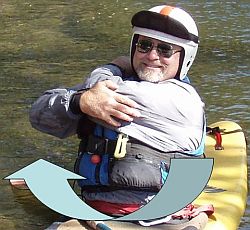 |
Shoulders/Torso 2.Lift your arm up and put your wrist behind your head, use the other hand to pull the wrist towards the opposite shoulder. To intensify the stretch bend your torso to the side in the direction that you are pulling. Hold the stretch with firm, continuous pressure for at least 40 sec. Repeat with the opposite arm. |  |
Torso stretch with paddle leverage.Stretching for torso rotation was described in a previous post. Stretch until you can see the stern (back end) of your boat. Hold the stretch with firm, continuous pressure for at least 40 sec. Repeat on the opposite side. | 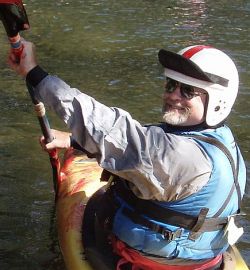 Photos by CarolynD. |
When is the best time to stretch? Whenever you feel stiff or sore! Before, during and after kayaking! And don't forget to stretch first thing in the morning on the day after the big kayaking trip. If your muscles are stiff and cold it is important to ease into your stretching slowly and gently, maybe after spending a few minutes in a hot shower.
If you are injured - take it easy until it heals and/or go see your doctor, but whenever you are just a little stiff and sore it is amazing how much better you will feel after you stretch!!
More about: Whitewater Kayaking Techniques. Stretching Techniques. Books on Stretching.
Tags: kayaking, whitewater, rivers.
Labels: technique
Monday, September 25, 2006
Stretching for Torso Rotation and Kayak Paddling Performance
Torso rotation is the motor you should be using to power your kayak, so stretching and loosening up your torso rotation muscles is a good way to start your day of kayaking, and maybe again as a wakeup call after a leisurely lunch.
You can just jump onto the river and stretch out as you paddle down the river, but why be stiff and clumsy for those first hours of every kayaking trip? You'll perform better and have more fun on the river if you do the stretching exercises you need before you put in !!
Stretching may not be that important for flexible, young kids, but stiff, old men like me really need to pay attention to stretching if we want to keep on paddling down our favorite rivers.
More about: Kayaking Techniques. Stretching Techniques. Books on Stretching.
Tags: kayaking, whitewater, rivers, paddling.
Torso stretch with paddle leverage.Bottom hand: reach across the bow (front) of your kayak. Place the power face of the paddle against the bow.Top hand: push out using the vertical paddle for leverage. This allows you to rotate your torso towards the stern (back) of your kayak. Push with continuous, moderate pressure and hold the stretch for at least 40 sec. Then switch sides and stretch your rotators on the other side of the kayak. |  Photo by TaylorC. |
You can just jump onto the river and stretch out as you paddle down the river, but why be stiff and clumsy for those first hours of every kayaking trip? You'll perform better and have more fun on the river if you do the stretching exercises you need before you put in !!
Stretching may not be that important for flexible, young kids, but stiff, old men like me really need to pay attention to stretching if we want to keep on paddling down our favorite rivers.
More about: Kayaking Techniques. Stretching Techniques. Books on Stretching.
Tags: kayaking, whitewater, rivers, paddling.
Labels: technique
Sunday, September 10, 2006
All Braces Should be LOW Braces - Kayaking Paddle Technique
1. Bracing on the surface of the water with your kayak paddle can help provide the support that you occasionally need when kayaking in whitewater. This can help you to maintain/regain your balance and to stay upright in your kayak.
The key principles of bracing are:
a) paddle face flat on the surface of the water (either the power face or the back face of the paddle)
b) paddle shaft very low and held parallel to the surface of the water
c) maintain a LOW center of gravity
- keep arms very LOW while sitting upright with an aggressive forward posture
d) always brace on the down-current side
- normally the direction in which you are trying to go!
- remember eddy currents are opposite from the main flow
e) maintain your paddler's box
- keep your arms extended straight and low in front of you
2. Some paddlers make a big deal about "high-brace" vs. "low-brace" depending upon how you bend your wrist and which face of the paddle is down on the water when you brace. In the pictures below notice the differences between the low-brace and the high-brace:
That's right! There are no great differences between the low-brace and the high-brace. You can totally forget about this silly low brace vs. high brace nonsense!! Remember - All Braces Are LOW Braces!! At the moment when you need some support get a paddle face down flat on the surface of the water ASAP. Either paddle face will do. Use whichever one is most convenient at the moment. Bend your wrist however necessary to make it happen. And keep it LOW !!
3. Other paddling strokes have some brace-like value, so just maintaining your aggressive paddling may provide all the support you need to stay upright. In those cases when you interrupt your normal paddling to put down a brace it is important to resume your aggressive paddling as soon as possible. The brace will provide a moment of support, but your other paddling strokes are needed to get you through the rapid.
More about: Kayaking Techniques.
Tags: kayaking, whitewater, rivers, paddling.
The key principles of bracing are:
a) paddle face flat on the surface of the water (either the power face or the back face of the paddle)
b) paddle shaft very low and held parallel to the surface of the water
c) maintain a LOW center of gravity
- keep arms very LOW while sitting upright with an aggressive forward posture
d) always brace on the down-current side
- normally the direction in which you are trying to go!
- remember eddy currents are opposite from the main flow
e) maintain your paddler's box
- keep your arms extended straight and low in front of you
2. Some paddlers make a big deal about "high-brace" vs. "low-brace" depending upon how you bend your wrist and which face of the paddle is down on the water when you brace. In the pictures below notice the differences between the low-brace and the high-brace:
"Low brace." | "High brace."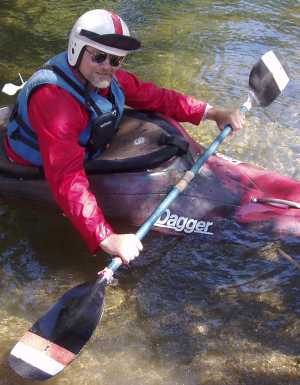 |
That's right! There are no great differences between the low-brace and the high-brace. You can totally forget about this silly low brace vs. high brace nonsense!! Remember - All Braces Are LOW Braces!! At the moment when you need some support get a paddle face down flat on the surface of the water ASAP. Either paddle face will do. Use whichever one is most convenient at the moment. Bend your wrist however necessary to make it happen. And keep it LOW !!
3. Other paddling strokes have some brace-like value, so just maintaining your aggressive paddling may provide all the support you need to stay upright. In those cases when you interrupt your normal paddling to put down a brace it is important to resume your aggressive paddling as soon as possible. The brace will provide a moment of support, but your other paddling strokes are needed to get you through the rapid.
More about: Kayaking Techniques.
Tags: kayaking, whitewater, rivers, paddling.
Labels: technique
Wednesday, September 06, 2006
Common Kayak Paddling Mistakes
Some kayaking skills are counter-intuitive. Training is needed to avoid these mistakes and to learn the skills needed for success in whitewater kayaking and sea kayaking.
1. Paddle hugging. Beginners tend to hold their paddles too close to their bodies. These "paddle huggers" then propel their layaks with elbow bending. Kayakers need to extend their arms straight and maintain a good strong paddler's box as they paddle. Hold the paddle as far from your body as you can through all of your paddling strokes.
2. Lack of torso rotation. Beginners tend to lock their torso and shoulders in the forward position. Kayakers need to power the paddle with straight arms and torso rotation to get the benefits of their big, strong, high endurance torso muscles. This is also critical for avoiding injuries to arms and shoulders while paddling.
3. Air bracing. Beginners tend to hold their paddles too high in the air and often raise their paddles even higher when the river grabs their boats and starts tossing them around. Air bracing means no support from bracing on the water, a high center of gravity, and often quickly results in a flipped boat and a swim. Kayakers need to keep their paddler's box down low on the decks of their kayaks, except when raising one hand at a time for a vertical stroke like the forward paddle.
4. Paralysis. Beginners often freeze up and stop paddling when the whitewater action starts to overwhelm them (i.e. sensory overload). In many cases all they need to do is maintain aggressive paddling to get through the rapid. Of course, when heading into a serious hazard a course correction is needed and then more aggressive forward paddling to avoid the hazard.
5. Leaning back. Beginners often lean back when big waves threatens to crash in their faces or over their heads. This is a natural reflex for many, but doesn't serve us well on the river. Maintain your upright posture and aggressive forward lean at all times. At that last second when it is too late to avoid the wave leaning back only makes it more likely that the wave will knock you over backwards. Often you can punch through these waves by maintaining your rhythm of aggressive forward paddling. Or you might stab the wave in the gut, use your paddle as a momentary brace, let the wave crash over your head and very quickly resume forward paddling.
6. Leaning upstream. Most beginners experience most of their flipped boats when they shift their body weight to the upstream side of their boat (e.g. during an eddy turn) and/or drop the upstream edge of their boat. It happens so fast that beginners are repeatedly slammed down before they realize what is happening to them. Many experienced boaters can see what is happening and are already paddling out for the rescue before the beginner's head hits the water. Successful kayakers must maintain weight control, edge control and paddle bracing on the downstream side of their boats.
More about: Kayaking Techniques.
Tags: kayaking, whitewater, rivers, paddling.
1. Paddle hugging. Beginners tend to hold their paddles too close to their bodies. These "paddle huggers" then propel their layaks with elbow bending. Kayakers need to extend their arms straight and maintain a good strong paddler's box as they paddle. Hold the paddle as far from your body as you can through all of your paddling strokes.
2. Lack of torso rotation. Beginners tend to lock their torso and shoulders in the forward position. Kayakers need to power the paddle with straight arms and torso rotation to get the benefits of their big, strong, high endurance torso muscles. This is also critical for avoiding injuries to arms and shoulders while paddling.
3. Air bracing. Beginners tend to hold their paddles too high in the air and often raise their paddles even higher when the river grabs their boats and starts tossing them around. Air bracing means no support from bracing on the water, a high center of gravity, and often quickly results in a flipped boat and a swim. Kayakers need to keep their paddler's box down low on the decks of their kayaks, except when raising one hand at a time for a vertical stroke like the forward paddle.
4. Paralysis. Beginners often freeze up and stop paddling when the whitewater action starts to overwhelm them (i.e. sensory overload). In many cases all they need to do is maintain aggressive paddling to get through the rapid. Of course, when heading into a serious hazard a course correction is needed and then more aggressive forward paddling to avoid the hazard.
5. Leaning back. Beginners often lean back when big waves threatens to crash in their faces or over their heads. This is a natural reflex for many, but doesn't serve us well on the river. Maintain your upright posture and aggressive forward lean at all times. At that last second when it is too late to avoid the wave leaning back only makes it more likely that the wave will knock you over backwards. Often you can punch through these waves by maintaining your rhythm of aggressive forward paddling. Or you might stab the wave in the gut, use your paddle as a momentary brace, let the wave crash over your head and very quickly resume forward paddling.
6. Leaning upstream. Most beginners experience most of their flipped boats when they shift their body weight to the upstream side of their boat (e.g. during an eddy turn) and/or drop the upstream edge of their boat. It happens so fast that beginners are repeatedly slammed down before they realize what is happening to them. Many experienced boaters can see what is happening and are already paddling out for the rescue before the beginner's head hits the water. Successful kayakers must maintain weight control, edge control and paddle bracing on the downstream side of their boats.
More about: Kayaking Techniques.
Tags: kayaking, whitewater, rivers, paddling.
Labels: technique
Tuesday, August 29, 2006
Forward Paddle Stroke for Propelling Your Kayak - Animation
| Although the river provides much of our forward momentum, whitewater kayak paddlers need a powerful, efficient forward paddling stroke for navigating with the current, across the current or against the current at critical moments. The explosive power and high endurance paddling strokes needed for kayaking at a high level come from torso rotation. | 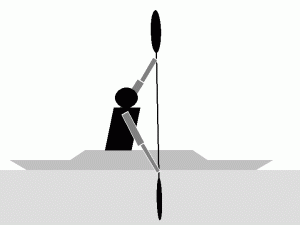 |
A. Forward Paddle Stroke - from the kayaker's perspective.
Forward Stroke Animation 1 (opens in a new window).
1. 90 degree rule sets hand positions on the paddle; extend arms straight to form a strong paddler's box.
2. Tilt your paddler's box on its edge with your left hand as the top hand.
3. Rotate left and plant your vertical paddle completely in the water at the bow on the right.
4. Rotate torso to the right to power the paddle.
5. The forward stroke ends when the paddle blade reaches your hip.
B. Forward Paddle Stroke - from the river's perspective.
1. Animation 1 above was done from the kayaker's perspective, but what is really happening is seen from the river's perspective. When you "plant" your paddle blade in the water it stays fixed at that location. Your torso rotation actually moves your kayak ahead to the location where your paddle is "planted."
Forward Stroke Animation 2 (opens in a new window).
More about: Kayaking Techniques.
Tags: kayaking, whitewater, rivers, paddling.
Labels: technique
Thursday, August 24, 2006
Sweep Stroke for Turning Your Kayak - Animation
| In river kayaking the river establishes the primary direction of travel, but kayakers often need to go in another direction for safety, fun, or rest along the way. Thus, turning your kayak in the direction you want to go is a fundamental skill. The sweep stroke is the primary method used to turn your kayak. | 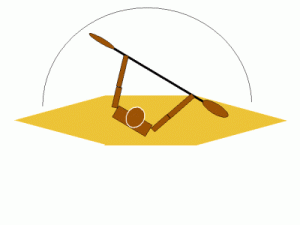 |
A. Forward Sweep Stroke.
Forward Sweep Stroke - Animation 1 (opens in a new window)
To do a forward sweep stroke on the left side of your kayak:
1. Maintain straight arms and a strong paddler's box through the entire sweep stroke (see post "How to hold your kayak paddle").
2. The sweep is a flat, horizontal stroke. Keep your entire paddle shaft as low as you can throughout the entire stroke.
3. Rotate to the right. Plant your paddle blade entirely in the water on the left side at the bow (front) of your kayak. The power face of the paddle should be facing towards the stern.
4. Rotate your paddler's box to the left via torso rotation (see post "Principles of kayak paddling strokes").
5. A full sweep stroke ends when the paddle blade reaches the stern (rear) of your kayak. Partial sweep strokes are often done if only a little change of direction is needed. A partial sweep stroke can begin and end anywhere along the arc of a full sweep.
6. Also practice the forward sweep on the right side of your kayak.
7. Forward sweep strokes help to maintain your forward momentum while providing the change of direction needed.
B. Forward Sweep Stroke - from the River's Perspective.
1. Animation 1 above was done from the kayaker's perspective, but what is really happening is seen from the river's perspective. When you "plant" your paddle blade in the water it stays fixed at that location. Your torso rotation actually rotates your kayak underneath you relative to the location where your paddle is "planted."
Sweep Stroke Animation 2 (opens in a new window)
C. Reverse Sweep Stroke.
1. To do a reverse sweep on the left side of your kayak first rotate your paddler's box to the left. Plant the paddle blade entirely in the water next to the stern of your kayak with the back face of the paddle blade facing toward the bow of your kayak. Rotate your torso to the right.
2. Partial reverse sweep strokes are often done when only a little change of direction is needed.
3. Also practice the reverse sweep stroke on the right side of your kayak.
4. Reverse sweep strokes will reduce your forward momentum while providing a change of direction. Sometimes that is good, sometimes not. Notice that a forward sweep on one side of the kayak gives the same change of direction as a reverse sweep on the other side of the kayak, so choose wisely depending upon whether you want to maintain or lose your forward momentum.
More about: Kayaking Techniques.
Tags: kayaking, whitewater, rivers, paddling.
Labels: technique
Tuesday, August 22, 2006
Principles of kayak paddling strokes - Paddler's Box & Torso Rotation.
Paddler's Box & Torso Rotation protect against elbow tendonitis and shoulder dislocation.
Perfecting your paddle strokes is important both for performance on the water and for prevention of common paddler's injuries.1. Use torso rotation to power all paddling strokes because big torso muscles are stronger and have more endurance than skinny arm muscles. Wide separation of your hands on the paddle (see 90 degree rule in post "Holding the paddle") limits the range of motion you can get with elbow bending and helps force you to power the paddle with torso rotation.
2. Paddler's Box. Keep arms straight to efficiently transmit your torso rotation power to your paddle and to maintain your paddler's box (see paddlers box in post "Holding the paddle").
3. Keep hands and paddle down low (except for top hand on forward and other vertical strokes) to maintain a low center of gravity and keep the paddle blades in position for flat strokes like sweep and brace.
4. Elbow tendonitis. If you can get "tennis elbow" from a few hours per day of tennis, imagine how much damage you can do from all day long paddling trips. I got "paddler's elbow" a while back and lost many weekends of kayaking waiting for it to heal up. Then I learned how to paddle correctly with straight arms and haven't had any more sore elbows since then, despite many years of long and hard kayaking.
| 5. Shoulder dislocation. There is little or no risk of shoulder dislocation when arms are kept low and held straight in front of the shoulders in a good, strong paddler's box. a) When the river starts to tumble you around (e.g. getting trashed in a big hole) letting your hands get up to shoulder level is dangerous. When the river grabs your paddle blade and throws your arm even higher, then you are in a dislocation risk zone. | 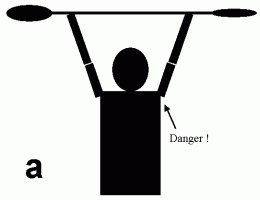 |
| b) Letting your elbow or c) elbow and hand get behind your chest breaks down your paddler's box, opens up your shoulder and places you in danger. Again, if the river grabs your paddle blade and pushes even farther, then you are in another dislocation risk zone. Shoulder dislocation is a big, scary injury. Although many recover sufficiently to return to paddling, nobody ever makes a full recovery from this injury. Once a shoulder has been dislocated you are likely to have repeat dislocations of that shoulder in the future. Paddling with straight arms and torso rotation provides almost perfect protection against this debilitating injury. | 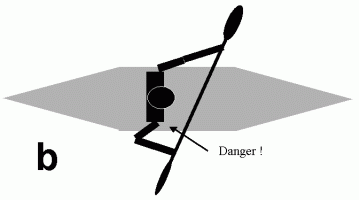 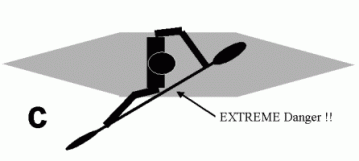 |
6. Bottom line. Both for better performance and for protection against common paddling injuries everybody should be sure to learn proper paddling technique. Lets all have fun, perform well and be safe out there !!!
More about: Kayaking Techniques.
Tags: kayaking, whitewater, rivers, paddling
Labels: technique





